Have you ever been SO sure you were picking up on something about a person or a situation, only to find yourself completely confused by their actions? And suddenly, you’re questioning your entire perception. Did I imagine the whole thing? Did I completely misread this situation?
This conversation was inspired by a tricky situation I recently found myself in, but I can think of at least a dozen previous examples of this in my life. And if you consider yourself intuitive, I’m pretty sure you’ll share in this experience with me.
I’ve talked quite a bit about intuition on The Energy Xchange, particularly around what it means for our lives. And before we know it, we’re building expectations around that. So when things don’t turn out the way we anticipated, we start questioning whether our intuition was wrong in the first place.
But what if our perception WAS accurate? What if the disconnect happened somewhere between what we noticed, what we decided it meant and what we expected to happen as a result?
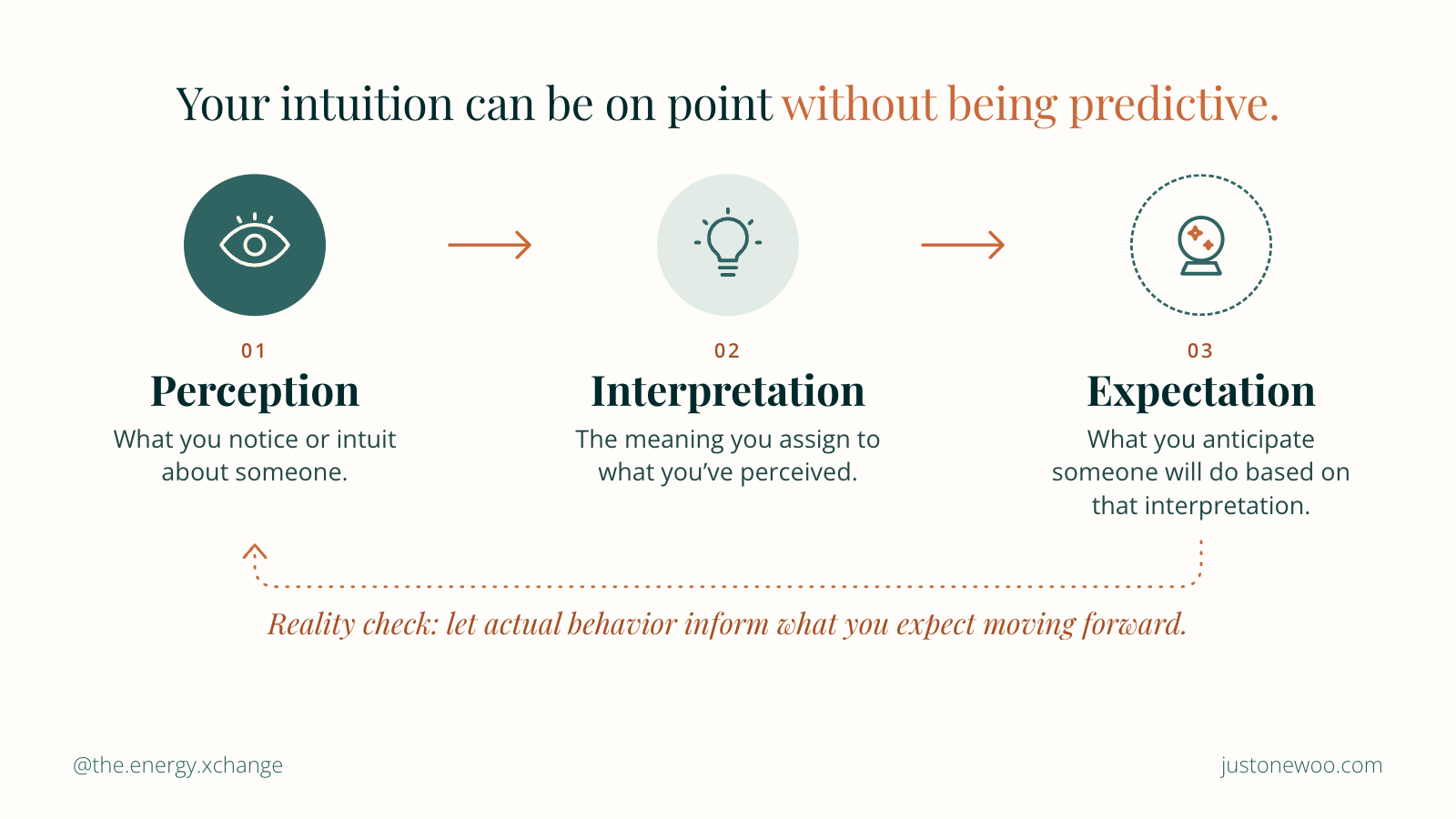
Our intuition can be on point without being predictive.
So how do we trust our intuition without allowing our interpretations and expectations to dictate what we do with that information?
But here's where it gets tricky: We start assigning meaning to whatever we've perceived, particularly around what it means for our lives.
And before we know it, we're building expectations around that.
So when things don't turn out the way we anticipated, we start questioning whether our intuition was wrong in the first place.
But what if our perception WAS accurate? What if the disconnect happened somewhere between what we noticed, what we decided it meant and what we expected to happen as a result?
Our intuition can be on point without being predictive.
So how do we trust our intuition without allowing our interpretations and expectations to dictate what we do with that information?
Where perception turns into expectation
I think it helps to separate three things that we tend to lump together.
The first is perception. This is what we’re actually noticing or picking up on. Maybe it’s someone’s behavior, a shift in their energy, a pattern we’re recognizing, or maybe it’s just a feeling we have about something that we can’t quite explain yet.
The second is interpretation. We might sense that someone is interested in us, for example. But deciding that their interest means they’re looking for a relationship with us? That’s an interpretation.
And the third is expectation. That’s what we believe is going to happen as a result of that interpretation. They’re all connected, and they all play a role here.
When you think you're up for a promotion
A good example of this is thinking you're up for a promotion at work. I've had this one happen to me. Let's say your boss has been giving you more responsibility, praising your work, including you in important meetings and asking for your input on bigger decisions. Your interpretation might be that they recognize your value, see your leadership potential and are considering you for advancement. So a natural expectation is that you're going to get promoted or be offered an advancement opportunity.
But reality doesn't always match that, right? Maybe someone else gets promoted. Maybe they bring in an outside hire. Maybe the opportunity never materializes, or at least not on the timeline you were imagining.
Your perception may have been completely accurate. Your boss genuinely values you. They recognize your abilities. They might even believe you're deserving of a promotion. But that doesn't necessarily mean they're prepared, willing or able to promote you. Maybe there isn't room in the budget. Maybe someone else is better suited for the role. Maybe your boss doesn't have the authority to make that decision.
None of those possibilities invalidate what you originally perceived. But if you interpreted that recognition as a promise of advancement, you've created an expectation that their actions may never have supported. And here's where that becomes especially important. Or maybe problematic is a better word.
If you're living in that expectation, how is it influencing your behavior?
Maybe you're turning down interviews or job offers elsewhere because you assume something is coming in your current workplace. Maybe you're hanging out in a position you've outgrown. Or taking on additional responsibilities without discussing compensation or advancement. And if you're not one for confrontation, and that was certainly me, maybe you're putting off conversations about your career goals because you assume your boss is already working toward the same outcome you are.
In all of those cases, your expectations aren't just affecting how you feel. They're influencing the actual choices you're making, and maybe limiting the paths available to you. There can be some pretty significant behavioral consequences to our expectations.
When you expect a relationship to go somewhere
And we can apply that same progression to romantic relationships. Maybe you recognize genuine affection, compatibility and perhaps even a shared vision of the future with someone. You interpret that as the person seeing you as a potential long-term partner. So you naturally expect that the relationship is progressing toward marriage or a deeper commitment. But maybe their actions don't consistently demonstrate that they're actively working toward that future with you.
Again, your perception may have been accurate. There may be genuine love, connection and compatibility. But that doesn't automatically mean the other person wants marriage, is ready for it or intends to pursue it with you.
And now what? When you've organized your life around an expectation that hasn't actually been established? Maybe you're making major life decisions based on an assumed shared future. Passing up opportunities that would require relocating. Avoiding conversations about commitment because you assume you're already on the same page. It becomes really easy to continue investing in a particular future rather than evaluating the relationship as it currently exists.
And I've done this! I have literally postponed planned relocations because of my interpretation of a man's romantic interest or availability, and my expectations around that. I've turned down job offers because of my interpretation of advancement opportunities in a workplace. Looking back, I can see how my expectations were influencing my behavior in the present, based on a future that existed primarily in my interpretation of the situation.
Two seemingly contradictory things can both be true
The challenge isn't necessarily that we've imagined something that isn't there. And that's where this gets a little murky for anyone with more intuitive traits. We may have accurately perceived something to be real, but then built expectations around it that were never supported by action. And when those expectations aren't met, we can find ourselves questioning our entire sense of perception or intuition.
But perhaps both things are true.
Someone can recognize your professional value without being able to promote you. Someone can genuinely love you without wanting to marry you. We can spend so much energy trying to figure out which of those things is true, when they might both be.
And I think that's where I was getting stuck over and over in situations. Because when someone's behavior doesn't align with what I've perceived about them, I tend to want to make sense of that discrepancy. Was I wrong about what I was picking up on? Did I misinterpret something? Or is there something else going on that explains why they're not acting on it? And holy shit, can I spend an awful lot of energy trying to figure that out.
But something shifted for me when I realized I didn't actually have to resolve that contradiction. Maybe what I perceived was real. Maybe I was right about some of it. Maybe I wasn't. But in either case, their actions were still their actions.
We don't have to change our perception of a situation to accept the reality of what people are showing us.
I can't tell you how much that realization has changed my irritation with situations like this. At some point, we have to get over trying to figure out which version of a person or situation is true. Because this AND that can both be true. They can coexist.
When our strengths complicate our expectations
For my fellow deep feelers, I want to touch on why I think this can be particularly challenging for us. Because so many of our natural inclinations, to hold space, appreciate nuance, understand people and see the best in them, can complicate how we interpret situations.
We're often really good at seeing beneath the surface. We can understand why someone behaves a certain way. We can appreciate the experiences that have shaped them. We can see potential that they might not even recognize in themselves. All wonderful qualities. Superpowers.
But sometimes, because we're able to see all of that, we start giving those things more weight than someone's actual behavior. We think, "I know they're capable of more than this." And maybe they are. But their capacity to do something doesn't necessarily mean they're willing to do it. Or that they're going to do it on your timeline. Or ever.
And sometimes understanding why someone is behaving a certain way makes us more inclined to accommodate that behavior. We can see that they're scared. Or that they've been hurt. Or that they're dealing with something difficult. And we hold space for that. Again, beautiful. God bless.
But understanding someone's behavior doesn't mean that behavior stops having an impact on you. You can have compassion for someone AND recognize that what they're offering isn't what you want or need. You can see someone's potential AND recognize that they aren't currently living up to it. Someone's limitations don't need to become our responsibility to work around. Not when it's having a significant impact on our own decisions or choices.
And our ability to understand people does not mean we can predict what they're going to do. This is where our strengths can become a bit of a liability if we don't check ourselves.
The frustration of unmet expectations
I've always believed that one of the biggest sources of disappointment is unmet expectations. And sadly, we're often the ones creating those expectations, especially when they're based solely on our perceptions and the interpretations we've made of them.
And I don't say that to excuse other people's behavior or suggest that all frustration is misplaced. People absolutely make promises they don't keep. They can mislead us. They can behave inconsistently. Sometimes they'll tell us one thing and do another. That's real, too.
But I do think we have to examine the role our own expectations play in our experience. Because sometimes nobody actually promised us the thing that we're disappointed to not receive. We just believed it was coming.
And I think this can be especially frustrating when we feel confident in our intuition. Because there's almost this extra layer of irritation. It's not just that the person isn't doing what we expected. It's that we feel like we've accurately perceived something about them, but their behavior doesn't make sense in light of that.
So we keep trying to figure it out. We look for more evidence. We replay conversations. We analyze their behavior. We go back and forth between believing we were right and convincing ourselves we must have been completely wrong. And before we know it, we're investing a tremendous amount of energy into trying to reconcile something that might not actually need to be reconciled. And perhaps can't be reconciled.
There's an invitation there to recognize when we're doing that, before we spend any more energy looking for an explanation.
Trusting your intuition without asking it to predict the future
So what do we actually do with all of this? Because I don't think the answer is to stop trusting our intuition or to second-guess everything we perceive. But I do think there's an opportunity to be more intentional about what we do with that information, especially when we're making decisions that can have a pretty significant impact on our lives.
And to be clear, I'm not a therapist or trained professional here. I'm bringing this conversation forward as a deeply feeling person who's trying to take a little more of an outsider's perspective on my own experiences. But in my view, it really comes down to a few things.
First and foremost, trusting what we notice, but remaining curious and open about what it means.
And then not locking ourselves into one interpretation of a situation and then building an entire set of expectations around it.
If we can recognize when we've moved from perception into interpretation, and be willing to question what we're assuming will happen next, that goes a long way. Remember that someone's potential, capacity or feelings do not guarantee action that's aligned with those things.
And most importantly, we let actual behavior inform what we expect moving forward.
And that's something I'm becoming much more aware of in my own life. The goal isn't to become less intuitive, less empathetic or less willing to see the best in people. Those are our gifts. They're our superpowers. We just need to stop asking our intuition to tell us things it cannot reliably tell us, no matter how on point we believe it to be. We've all got free will, and people are gonna be people'ing.
So here's something to consider: Where in your life might you be organizing your choices around an expectation that hasn't actually been established?
Ready to trust what you notice (without needing it to predict)?
If this one landed, The Energy Xchange is full of conversations like it, for deep feelers and quiet leaders who pick up on everything and want to do something useful with it. New episodes drop every Wednesday.
Catch Episode 49 of The Energy Xchange, "How to Trust Your Intuition When Their Actions Don't Match," wherever you listen to your podcasts.
Was my intuition wrong if someone didn't act the way I expected?
Not necessarily. Your perception can be accurate while the meaning you gave it, and the expectation you built from it, never get supported by the other person's actions.
What's the difference between intuition and expectation?
Intuition is what you notice, often before you can explain it. An expectation is what you believe will happen because of what you decided that noticing meant.
How do you trust your intuition without overthinking it?
Trust what you notice, stay curious about what it means and let the person's actual behavior shape what you expect next. You don't have to resolve every question about what they think or feel to make a decision.